There are courses you play, and then there are courses that play you. Winged Foot is the latter, both of them. For the entire trip leading up to this day, we had been talking about Tillinghast. His creativity, his craftsmanship, his insistence on building what he called “man-sized courses.” At Francis Byrne, we saw the influence of his contemporaries. At Essex County, we walked holes he designed. But Winged Foot is Tillinghast at his peak, the place where everything he believed about the game is executed across 36 intertwined holes with an intensity that borders on intimidating. And we were not leaving until we had walked every one of them.
We drove into Mamaroneck knowing that we were about to play one of the most significant properties in American golf. Six U.S. Opens on the West. Two U.S. Women’s Opens. Countless championships. The reputation precedes every step you take here, and the weight of that history is palpable the moment you walk through the clubhouse door and see the memorabilia on the walls. The photos, the flags, the scorecards from rounds that changed careers and altered the history of the game. Winged Foot runs on a first-come, first-served system. No tee times, just roll up and put your name on the board. We got there early. We had to. Thirty-six holes of Tillinghast was going to be a long day, and we did not want to miss a minute of it.
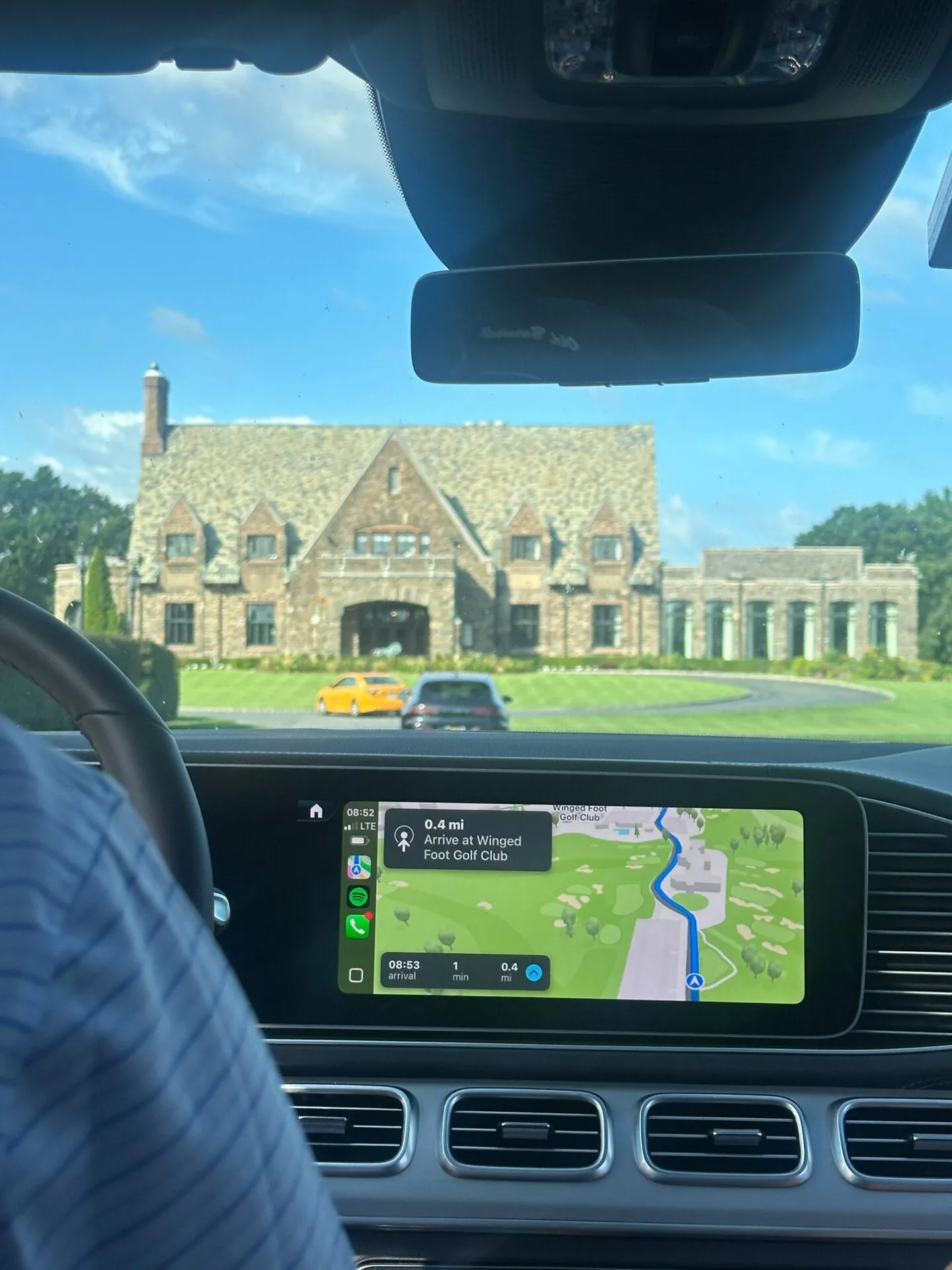
0.4 miles. Arrive at Winged Foot Golf Club. The GPS knew where we were going. We had known for months. The stone clubhouse through the windshield, 8:52 in the morning. Thirty-six holes ahead.
The West Course
We started on the West, the course the world knows from television, the one that has broken the hearts and made the careers of the best players in the game. Everyone warns you about the greens, and everyone is right to. They are the most feared putting surfaces in American golf for a reason. Nearly every green tilts from back to front, often dramatically, which means the challenge is not just reaching the green. It is reaching the correct part of the green. Miss your spot by ten feet and you might face a putt that is essentially unputtable, rolling off the front edge or breaking three feet on a twenty-footer that looked straight when you stood over it.
The first green gives you a taste of what is coming. It is a vast, tilting, sloping expanse that makes you question everything you thought you knew about reading greens. As a caddie, I have spent years studying putting surfaces, learning to see the subtle breaks that players miss. The greens at Winged Foot humbled that experience. They are alive in a way that most greens are not. Responsive to speed, to spin, to the slightest miscalculation of line. Gil Hanse’s restoration work has only sharpened these contours, revealing original pin positions that had been softened over the decades and restoring the full tooth of Tillinghast’s vision.
What makes the West relentless is the par fours. Ten of them stretch beyond 400 yards, and the closing six holes are brutal, starting with a 210-yard par three and followed by five par fours that offer almost no relief. By the time you stand on the 18th tee, you have been tested in every dimension of the game, and the 18th asks for one more great swing just to earn the right to putt out. But the course is not a slog. Even at its most demanding, the West rewards good golf with moments of beauty and satisfaction. The par fives are reachable if you take risks off the tee. The shorter par fours offer birdie chances that feel hard-earned rather than given away. And the 10th, a par three that Ben Hogan once described as a shot into someone’s bedroom, the green pressed up against a house just forty yards behind, is one of the most perfectly designed short holes in the game.
The East Course
Here is what the members will tell you: the guests play the West and the members play the East. After walking both, I understand why. The East does not have the championship pedigree or the television fame, but it might be the more enjoyable round of golf. Where the West beats you into submission through sheer length and intensity, the East engages you with variety, subtlety, and green complexes that are every bit as brilliant, and in some cases even more creative, than its famous sibling.
The East routing is a work of art in itself. Unlike the West, where the front nine returns to the clubhouse at the turn, the East does not come back until the 10th green. Tillinghast wraps the front nine around the perimeter of its section of the property, creating a sense of journey that the West’s tighter routing does not quite achieve. You feel like you are going somewhere, moving through distinct neighborhoods of the course, from open stretches with long views to intimate corridors framed by mature trees, before the back nine brings you home.
The greens on the East share the same back-to-front character as the West, but Tillinghast plays with that formula in more adventurous ways. There are greens with dramatic internal ridges, greens with false fronts that reject anything short, greens where the lateral movement is even more consequential than the front-to-back tilt. The distinctiveness of each putting surface is what makes the East so compelling on repeat play. You never feel like you are solving the same problem twice.
After 18 on the West, we were tired. After 36, both courses in a single day, we were something beyond tired. But it was the right kind of exhaustion, the kind that comes from complete immersion in something worth your full attention. Walking off the East, legs heavy and minds buzzing, the three of us agreed: you cannot understand Winged Foot by playing just one course. The West shows you what Tillinghast could do when he was building for the ages, for the U.S. Open, for posterity. The East shows you what he could do when he was building for the pure joy of the game. Together, they make one of the great 36-hole properties in the world.
The Clubhouse and the Culture
You cannot write about Winged Foot without mentioning the clubhouse. It is an experience unto itself. Old wood, memorabilia on every wall, the kind of atmosphere that you simply cannot manufacture. It accumulates over a hundred years of membership, of friendships forged and rivalries settled, of championships won and lost. Between our two rounds, we sat in there and soaked it in. The history on the walls, the easy energy of members coming and going, the sense that this place exists for golf and nothing else. Caddies are mandatory on both courses, and they are essential for navigating greens that would take years to learn on your own.
Winged Foot was, in many ways, the climax of our trip. We had been building toward this. Studying the architects, developing our eye, learning to see the design decisions that most golfers walk right past. And here, across 36 holes of Tillinghast’s finest work, everything came together. Not just the West, which the world already knows. But the East, the course the members keep for themselves, which might be the more complete expression of what Tillinghast believed golf could be. The education was not complete. It never is. But standing in that clubhouse with aching legs and full hearts, we understood something we had not before: that great golf architecture is not about making the game easier or harder. It is about making every single shot matter. And for 36 holes, every single one of them did.